Brokerages need to customise their EMS to avoid crossing orders with the MPIDs on external trading venues.
One of the major compliance issues for broker dealer firms is to avoid crossing each other’s orders at a particular exchange. If both sides of the order are represented by the same market participant identifiers (MPID) and if this action results in a price movement the broker firm could face potential fines or even temporary suspension from trading for price manipulation.
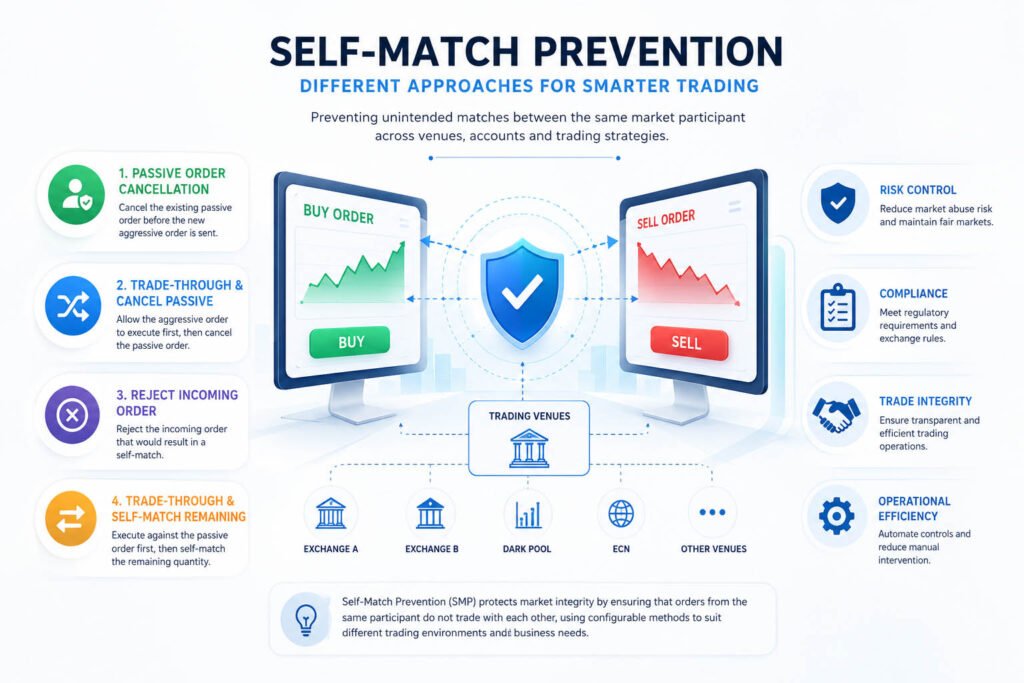
Although each individual desk internally crosses transactions, orders from two different desks with the same MPID can reach and cross on the exchange. To avoid these scenarios, exchanges and other external trading venues provide an option to enable Self-Match Prevention (SMP) across an MPID. This SMP can be enabled with several configurations, as described below:
Simply cancel a sitting passive order: If an incoming aggressive order will cause a self-match with an existing passive order, the passive live order is cancelled first and then the new aggressive order will participate in the market and any open quantity will sit in the market.
Trade through the market and cancel a sitting passive order: If an incoming aggressive order will cause a self-match with an existing passive order, the aggressive order will first participate with other entities in the market and any open quantity will sit in the market and the passive live order will be cancelled.
Reject an incoming (taking) order: If an incoming aggressive order will cause a self-match with an existing passive order, then the incoming aggressive order will be rejected while the passive order will continue to be live in the market.
Trade through the market and self-match the rest: If an incoming aggressive order will cause a self-match with an existing passive order, then the aggressive order will first execute with other live orders in the market and only the remaining quantity will be self-matched and this execution is marked as an “internal trade”. Also, the remaining orders will remain live in the market.
This is the best of all solutions since it avoids cancellation of any live orders and hence creates fewer order management system (OMS), position and trade risk complexities.
However, the choice depends upon the flavour of SMP implemented by the destination exchange and also the flavour the client prefers. Each implementation has its own set of challenges.
In configurations one and two, which involves the cancellation of an active live order, there are OMS and position risk issues. Since the order is cancelled by the exchange, the OMS has to have a stated provision or else manual intervention is required for the order to be resent to the exchange at a later time. Until then, the cancelled order results in a position on the book and hence is an open risk.
In configuration three, where all new crossable incoming orders are rejected, the OMS or a human trader has to continuously keep track of when the other aggressive crossable order can be resent for execution. This again produces a scenario where positions cannot be squared off instantly resulting in positional risk.
In configuration four, since the orders can cross with each other, the challenge is how these orders which are marked as “internal trades” are reported for clearing. If these self-crossed internal trades are not reported for trade clearing, then the broker dealer needs to filter out these internal executions so as to avoid trade brakes.
In all cases, additional custom development in the execution management system (EMS) is required to handle self-cross executions.